
At Mauve et Herbes, cultivation isn’t just about producing, it’s about observing, adjusting, and truly understanding how systems perform. In collaboration with CANNA, the team launched one of its most ambitious research projects to date: large-scale, outdoor product testing.
The goal is simple. Compare. Measure. And most importantly, understand what actually works.
A System Built for Precision
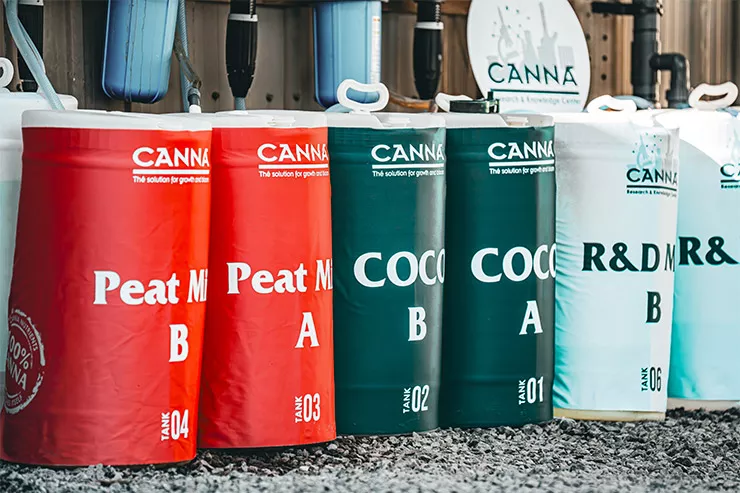
The project is structured across three distinct grow areas, each with its own substrate and nutrient approach:
- Peat-based substrate with CANNA Peat Mix
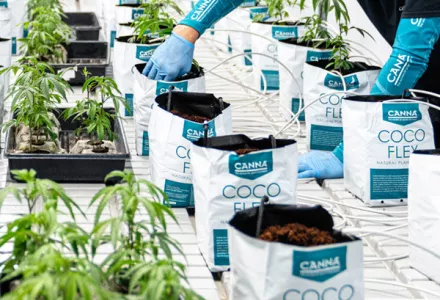
- Coco substrate with CANNA Coco A&B
- Coco substrate with an R&D nutrient formulation
Each section runs independently, with its own fully controlled recipe.
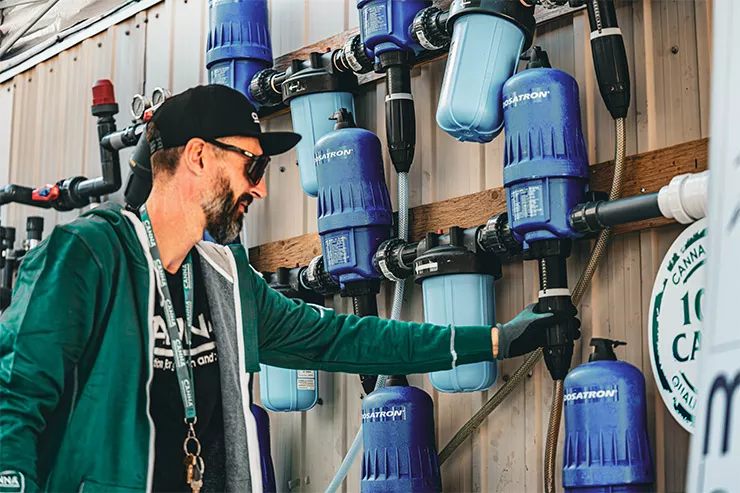
At the core of the system is precise irrigation tracking. Every milliliter delivered, from transplant to harvest is recorded. This provides clear insight into water usage, input costs, and the ability to forecast future cycles with accuracy.
Everything is adjustable:
- Irrigation frequency
- Volume
- Scheduling
- A&B nutrient injection
- pH control
Target parameters remain consistent across the board:
EC at 2.2, pH between 6.0 and 6.2.
Nothing excessive. Just what’s needed to stay in control.
Same Genetics, Different Conditions
To create a true comparison, the same cultivars were grown across different substrates. The results are clear. No deficiencies were observed across any of the recipes. Plants remained healthy in all systems.
However, some differences did emerge. In coco, plants showed slightly more vigorous growth: on average about 5–10% taller compared to peat. But that’s not where the real story is.
The Real Difference: Dryback Management
The most significant difference comes down to dryback control.
In coco:
- More uniform dryback
- Easier rehydration
- Better overall consistency
In peat:
- Less uniform drying
- More difficult to rehydrate once fully dry
- Greater variability across the crop
This is where system behavior becomes critical. When the substrate responds predictably, decision-making becomes easier and consistency follows.
Scaling Testing Without Compromise
In the R&D mix section, the team pushed things further.
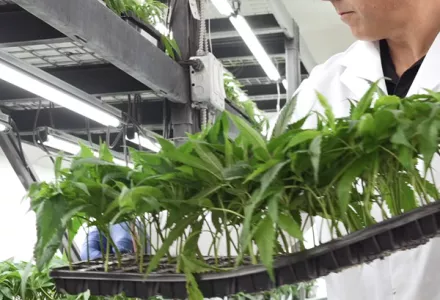
Approximately 40 different cultivars were grown simultaneously to test the robustness of the new formulation.
The goal wasn’t perfection, it was stress-testing the system:
- Nutrient deficiency response
- Performance across diverse genetics
- Overall stability
And the results speak for themselves.
The system holds up.
Simplicity, Consistency, Control
What stands out most in this project isn’t complexity, it’s simplicity.
Across both main approaches:
- A two-part nutrient system
- pH adjustment
- Nothing else
No unnecessary inputs. No overcomplicated feeding strategies.
Just a controlled, repeatable system that delivers.
What This Confirms
Projects like this reinforce a key idea:
There isn’t one “perfect” way to grow.
But some systems are easier to manage, and more consistent than others.
When:
- inputs are stable
- systems are measurable
- results are repeatable
Growers can focus on what actually matters.
The cultivation itself.